


konaai-newsletter-MIT Whitepaper
Employee 360

Intelligent Risk Monitoring of Employee Travel, Entertainment, Expenses, and PCard Activity

See What Every Expense Report Is Really Saying

Employee 360 applies a library of pre-built, customizable algorithms to expense, travel, and entertainment data to help organizations monitor employee activity.

Surface duplicate payments
and anomalies

Identify fake documents and
manipulations

Flag policy violations and
suspicious behavior
How Employee 360 Keeps Your Expense Data Honest

  Comprehensive Expense Monitoring

  High-Risk Employee Identification

Support stronger governance and oversight through a centralized view of spending behavior across:
  • Petty cash expenses
  • Personal charges
  • Miscellaneous out-of-pocket (OOP) expenses
Protect organizational security by flagging employees with patterns indicative of elevated risk:
  • Duplicate expense submissions
  • Split transactions
  • Anomalous expenses
  • High-dollar transactions

  Policy Circumvention and Violations

  Anti-Corruption

Strengthen policy adherence and uncover potential misconduct by identifying activity that attempts to bypass established controls:
  • Transactions that fall just under an approval limit
  • Expenses that far exceed policy thresholds
  • Repeated spending patterns causing concern
Enhance financial integrity through continuous monitoring for corruption-related risk indicators such as:
  • High-risk product purchases
  • Suspicious expense descriptions
  • Expense behavior that warrants review

Analyze Expense Receipts Beyond Transaction Data

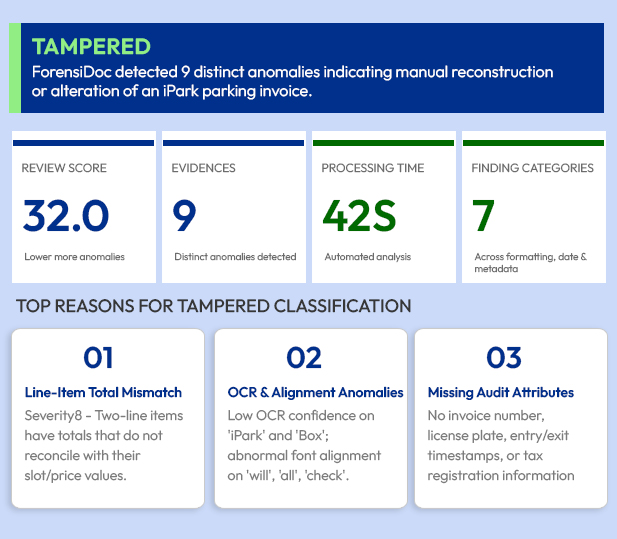
Employee 360 extends visibility beyond transaction records through receipt and document analysis capabilities. While machine learning and transaction risk scoring evaluate the expense as a whole, our Document Integrity capabilities analyze line-item details and the entire document.
  • Identify fake or AI-generated documents, contracts, and receipts
  • Flag suspicious or unauthorized line items, such as alcohol on a receipt
  • Detect incorrect dollar entries within the receipt itself

Built for Teams that Have to Answer for Every Dollar Spent

Compliance
Strengthen policy adherence and transaction monitoring to improve oversight of employee expense activity.
Internal Audit
Run consistent, documented checks across 100% expenses and T&E transactions and prioritize the highest-risk areas.
Finance and Accounts Payable
Monitor personal and miscellaneous out-of-pocket expenses alongside standard T&E review.
Risk and Investigations
Prioritize follow-up on employees whose activity consistently show duplicate, split, high dollar, or anomalous data.

Strengthen Employee Expense Oversight

One Platform. Unlimited Possibilities.

Single Intelligence Platform:
Works with any ERP, AP, procurement, HR, expense, travel, vendor, customer, banking, case management, hotline, and third-party data system

Proven Analytics Library:
Hundreds of algorithms, pre-built and mapped to fraud, compliance, and financial crime analytics

Reduced Manual Effort:
Digital AI agents that automate data collection, integration, testing, investigation support, documentation, and reportin

Measurable ROI:
Enhance risk classification using emerging information from OpenSanctions, LexisNexis, and internal transaction systems while continuously monitoring millions of transactions

Expertise:
Leverage 25+ years of proven anti-fraud analytics expertise

Scalable:
Improve decision-making, strengthen governance, and support regulatory expectations as the organization grows

Frequently Asked Questions

Product Overview

Who is Employee 360 built for?

Employee 360 is built for internal audit, compliance, risk, and finance teams responsible for reviewing employee expenses, T&E activity, and out-of-pocket (OOP) spend at mid-large organizations.

How is employee 360 different from a standard expense management tool?
Standard expense tools process and approve expenses. Employee 360 sits on top of that data to score risk, flag anomalies, and surface high-risk employees and transactions using purpose-built anti-corruption and fraud-detection algorithms.

konaAI’s Employee 360 is an anti-corruption expense integrity platform that applies 150+ pre-built, customizable algorithms combined with AI-powered document analysis to employee expense and travel & entertainment (T&E) data to identify fraud, policy
Does Employee 360 use machine learning?

Employee 360 combines machine learning and transaction risk scoring with receipt-level document scanning to evaluate both spending patterns and the underlying expense documentation. It includes 150+ pre-built algorithms, all of which are customizable to an organization’s specific expense policies and risk thresholds.

Risk Management

What Out of Pocket (OOP) expense risks does Employee 360 flag?

Employee 360 flags OOP expenses that fall outside expected patterns, including personal and miscellaneous charges that can indicate misuse of petty cash or reimbursement processes. It provides comprehensive expense management coverage for petty cash, personal charges, and miscellaneous OOP expenses, in addition to the standard T&E spend.

How does Employee 360 identify high-risk employees?

Employee 360 identifies employees with a consistent pattern of duplicate, split, anomalous, high-dollar, or otherwise suspicious T&E activity, rather than flagging a single transaction in isolation.

What is policy circumvention in expense management?
Policy circumvention is when a transaction is structured to avoid an approval limit or internal control.

Example: An expense filed just under a spending threshold instead of over it.

Employee 360 identifies transactions and expenses that fall just under a set limit, a common sign of circumvention, as well as those that far exceed it. It flags both ends of the pattern for review.
How does Employee 360 support anti-corruption programs?
Employee 360 includes anti-corruption algorithms that identify high-risk expenses and suspicious transaction descriptions or product purchases carrying potential bribery or corruption exposure.

Example: Vague or mismatched expense descriptions and unusual product purchases can indicate bribery or corruption risk, which Employee 360’s anti-corruption algorithms are designed to surface.

Document Analysis

What can line-item receipt analysis catch that transaction-level review misses?
It can catch suspicious or unauthorized items within a receipt such as alcohol on a business expense as well as incorrect dollar entries that wouldn’t be visible from the transaction total alone.

In addition to machine learning and transaction risk scoring, Employee 360 with Document Integrity capabilities scans expense receipts to analyze individual line items rather than only the total amount submitted.
Does Employee 360 flag unauthorized items like alcohol on expense receipts?
konaAI’s Document Integrity’s receipt scanning is built to identify specific unauthorized line items, such as alcohol charges, that violate expense policy even when the total dollar amount looks reasonable.