

konaai-newsletter-MIT Whitepaper
Retail 360

Point-of-Sale Fraud Management for Retail & QSR

The Need for Integrated and Automated Reporting for Restaurants, Fast Food Chains, and Retail

CHALLENGE
  • Fragmented Transaction Environments
    Retail and QSR organizations face growing fraud and leakage risk spread across increasingly disconnected systems and locations.
  • Evolving Employee Fraud Behavior
    Manual checks and static rules often struggle to detect evolving behaviors as employees adapt to known monitoring approaches.
SOLUTION
  • A Platform That Fits Your Strategy
    Retail 360 gives you a unified platform to identify suspicious refunds, voids, discounts, and overrides in real-time while reducing cash leakage.

Unify Siloed Operational Data and Reduce Investigation
Costs through Data-Driven Monitoring

Intelligent Automation for Fraud Analysis

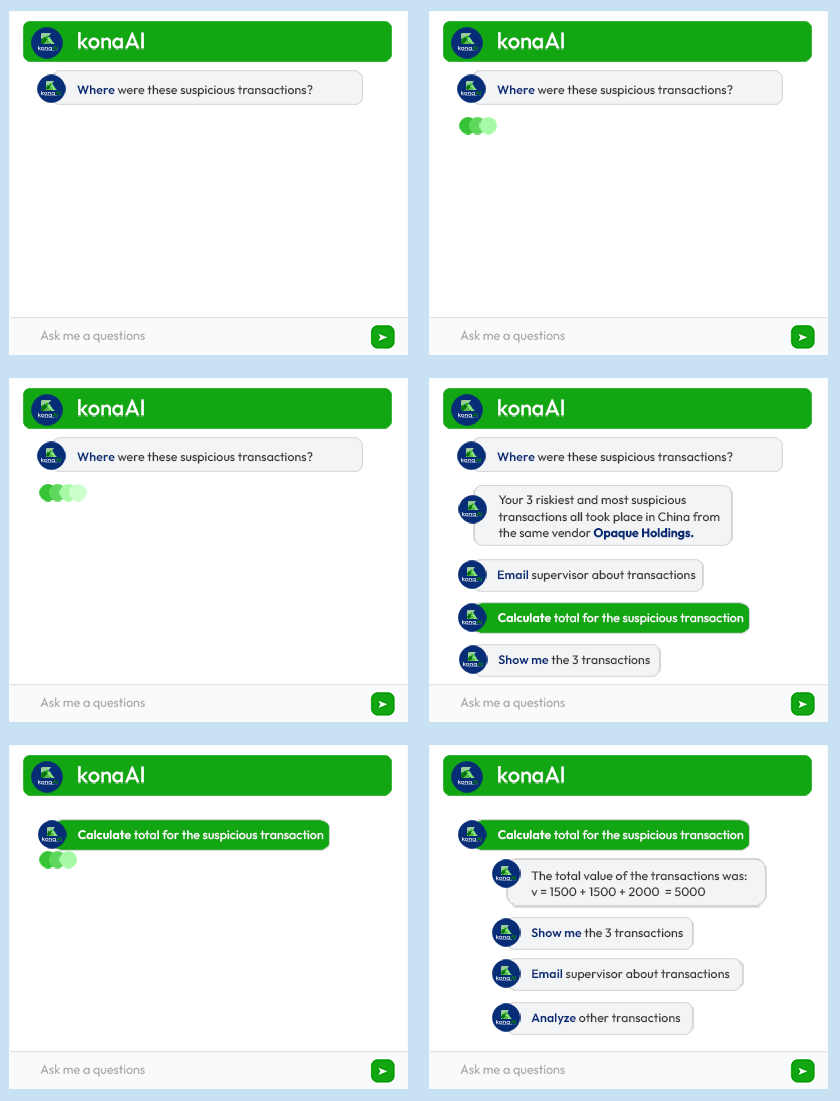
Retail 360 leverages agentic AI-powered digital assistants to support fraud detection and investigation workflows. These assistants help automate repetitive data gathering and analysis tasks by using historical data, policy frameworks, and transaction patterns. Enabling teams to focus human effort on stores, people, or transactions that require investigation or remediation.
  • Assist in reviewing alerts and identifying high-risk transactions
  • Support investigators by surfacing relevant historical and contextual data
  • Provide visibility and controls needed to monitor performance and manage costs
  • Improve investigation accuracy across every location, prioritizing what requires human attention

For Retail/QSR Transaction Risk, Revenue Leakage, and Loss Prevention

RETAIL ORGANIZATIONS
Monitor transactions, discounts, and overrides across multiple retail locations with real-time risk visibility.

QUICK SERVE RESTAURANTS
Detect POS fraud schemes and revenue leakage across high-volume, fast-paced QSR transaction environments.

LOSS PREVENTION TEAMS
Prioritize investigations with AI-driven risk scoring, so your team focuses on the highest-risk activity first.

INTERNAL AUDIT & FINANCE
Gain enhanced visibility on revenue performance, sales projections, and internal control effectiveness across locations.

From Reactive Reviews to Proactive, Continuous Monitoring

Internal Controls:
Align with leading COSO internal controls best practices

Visibility:
Improve visibility into higher-risk employees and store activity through configurable scoring and prioritized review

Robust Assessment Library:
Extensive library of proprietary sector-specific, anti-fraud schemes

Case Management:
Full case management, workflow, and transaction tagging / issue coding

Risk Ranking:
Multiple business processes to risk rank vendors, customers, or employees

Deployment:
Built to align with modern cloud, data, and AI strategies, including deployment within your Google Cloud environment

Frequently Asked Questions

Product Overview

What is Retail 360?
konaAI Retail 360 is a point-of-sale fraud management platform built for retail and quick serve restaurant (QSR) organizations. It unifies siloed operational data including POS transactions, inventory, and employee metrics into a consolidated risk view, enabling teams to detect suspicious refunds, voids, discounts, and overrides in real time.

Using agentic AI and machine learning, Retail 360 helps organizations move from fragmented, reactive review processes to proactive, continuous monitoring.
Who is Retail 360 designed for?

Retail 360 is designed for retail chains, quick serve restaurants (QSR), and fast-food organizations that need to manage POS fraud, revenue leakage, and loss prevention at scale. It is particularly valuable for:

  • Loss prevention and internal audit teams
  • Finance and operations leaders managing multi-location visibility
  • IT and data teams building out cloud and AI strategies

Fraud and Loss Prevention

What types of POS fraud does Retail 360 detect?
Retail 360 monitors for a broad range of POS fraud schemes including suspicious refunds, unauthorized voids, irregular discounts, and manager overrides. The platform draws on an extensive library of proprietary sector-specific, anti-fraud schemes built specifically for retail and QSR environments to identify both known and emerging fraud patterns.
How does Retail 360 reduce revenue leakage?
Revenue leakage is reduced through real-time transaction monitoring combined with risk-ranked investigation queues. By identifying anomalous activity at the point of sale, teams can act quickly. Multi-location performance monitoring also gives finance and operations leaders enhanced visibility into revenue performance and sales projections across the entire organization.
Can Retail 360 identify high-risk employees and store locations?
Retail 360 includes configurable scoring and prioritized review capabilities to surface higher-risk employees and store activity. Multiple business processes allow teams to risk rank vendors, customers, or employees based on behavioral signals and historical patterns.

Compliance and Controls

Does Retail 360 align with internal audit frameworks?
Retail 360 is designed to align with leading COSO internal controls best practices. It improves investigation speed, consistency, and control responsiveness, making it easier for internal audit teams to demonstrate a robust, documented monitoring program.
How does Retail 360 support continuous monitoring?
Unlike point-in-time audits, Retail 360 provides continuous, real-time monitoring across all connected locations and data sources. Models are continuously refined based on historical patterns, investigation outcomes, and similar risk signals, ensuring the platform becomes more accurate over time without requiring manual rule updates.
What reporting capabilities are included?

Retail 360 includes integrated and automated reporting covering:

  • Real-time performance monitoring across multiple locations
  • Revenue performance and sales projection visibility
  • Machine learning–enhanced accuracy metrics
  • Full case management audit trails with transaction tagging and issue coding